Commercial property handover checklist: what owners and occupiers should record
Published
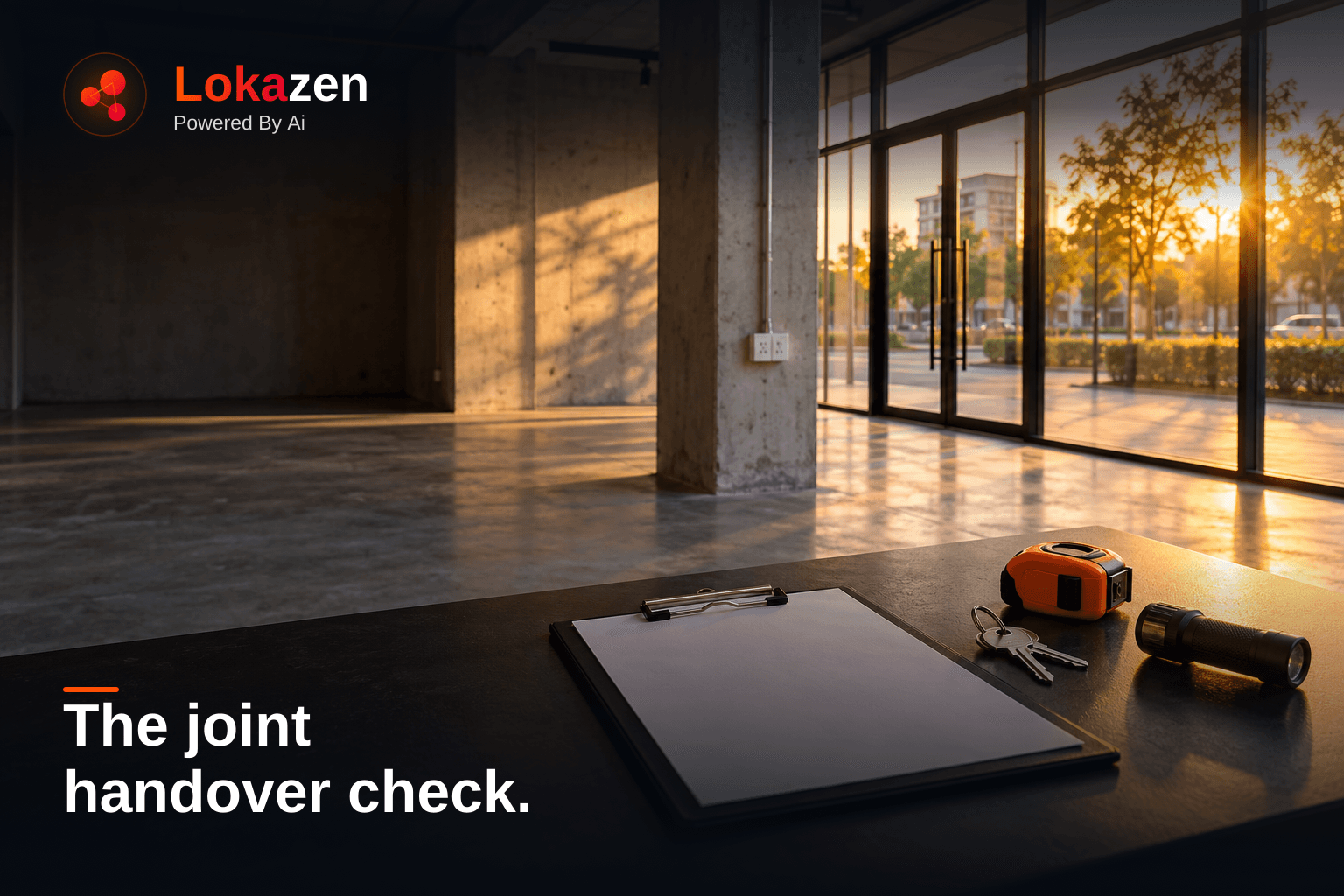
AI-generated editorial illustration. Not a listed property, verified location or measured layout.
A commercial-property handover should produce one dated record of the premises, supplied documents, tested systems, unresolved defects and access items. Give each open item a responsible person, an agreed next action and a defined completion check. Keep the physical inspection separate from decisions about contractual acceptance, possession, rent commencement and release of obligations, which need review against the actual agreement.
For a Bangalore property owner and an incoming brand, the challenge is often coordination. The contractor says the work is finished, the brand's designer has seen a different drawing, the keys are with building management and an electrical assessment is still outstanding. A joint inspection makes those differences visible before they turn into a disagreement about what was handed over.
This guide is an operational checklist for preparing and recording that inspection. It does not certify safety, legal compliance or suitability for a business. Use qualified professionals for technical checks and legal advisers for the implications of any signed record.
Begin by defining which handover is happening
Ask the participants to identify the purpose of the visit in writing. Is it an initial condition survey, a check before fit-out access, a reinspection after landlord works, or the physical transfer of the premises? Those milestones can have different consequences. Avoid a generic calendar invitation labelled "handover" when the parties expect different outcomes.
List the exact unit, floor and areas included. Identify the customer entrance, service access and relevant shared facilities. Confirm which proposed works are within the agreed scope and which remain requests. A desire expressed during a viewing does not become an owner obligation simply because it appears on a checklist.
Invite people who can answer the relevant questions: the owner's representative, incoming occupier, building manager, project coordinator and appropriate specialists. Record who can confirm a fact and who is authorised to agree a change. Attendance alone does not establish decision-making authority.
Prepare the inspection pack before anyone travels
Circulate the current plan and work list, with version dates. Include earlier inspection notes, relevant specifications and the inventory of items expected to remain. Ask for access to service areas needed for the agreed checks. If a room, riser or route cannot be accessed, flag the gap before the visit rather than discovering it after every participant has arrived.
Organise the pack into three evidence categories:
| Category | Example | What the record should say |
|---|---|---|
| Document supplied | Plan, utility record, equipment manual or approval copy | Received from whom, when, for which premises, and review status |
| Condition observed | Visible stain, missing fitting or door operation | Exact location, date, photograph and observation limits |
| Professional check | Electrical assessment or specialist system test | Professional, scope, method, result, limitations and report reference |
A document in a folder is not necessarily current or applicable to the offered unit. A working light does not establish that the electrical system suits the incoming equipment. Keeping these categories separate lets a reviewer identify what has actually been established.
Use a fixed route through the property
Begin at the street approach and follow the customer route to the unit. Record the building and unit identification, entrance condition, shutter or door operation, lighting and any dependence on a shared gate. Note the access arrangement that exists today rather than an improvement proposed for later.
Inside, divide the plan into labelled zones and inspect them in a consistent direction. In each zone, first record visible floors, walls, ceilings, doors and windows; then record fittings and service points. Continue through rear rooms, washrooms and accessible service areas. Mark any part outside the inspection scope.
Take a context photograph and a detail photograph for each material issue, where permitted. Name them using the item reference and location. A close-up without context can be difficult to locate during reinspection; a wide room photograph may conceal the defect the parties intended to record.
Use observable language. "Discolouration visible above rear doorway" is stronger evidence than "roof leak fixed badly" when neither cause nor repair quality has been established. Ask an appropriate specialist to investigate concealed damage, recurring water ingress or other matters beyond a visual check.
Check services against the incoming operation
The incoming brand should supply its proposed equipment and service needs in a form the technical reviewers can assess. The useful question is whether the documented installation and proposed load are compatible, not whether there are enough visible sockets.
- Electricity: identify the connection serving the unit, obtain relevant current records and request a qualified assessment of the proposed installation and equipment. Record what was inspected or tested and any outstanding load or service question.
- Water and drainage: identify the source and relevant connection arrangements, record accessible service points and have appropriate professionals investigate capacity or drainage suitability where the business depends on it.
- Ventilation and other plant: identify the actual route, equipment ownership, maintenance information and access needed for the proposed operation. Existing equipment should not be assumed compatible.
- Shared building systems: obtain building-management confirmation of access hours, service arrangements and responsibilities, with professional review where required.
If new utility work is said to be in progress, ask for its specific reference and status evidence. BESCOM's official connection tracker provides a route to check a request using a request or account identifier. BWSSB's official connection portal provides an application-status route. A submitted application or tracking entry should be recorded as such; it does not prove that a connection is operational or suitable for the intended business.
Do not open electrical panels, operate unfamiliar plant or enter an unsafe space to complete the sheet. Record the limitation and arrange the qualified check. A blank inspection box is preferable to an unsafe test or an unsupported assurance.
Build a snag register that someone can actually close
Give each issue one identifier. Record the location, observed condition, evidence, proposed action, responsibility and agreement status. Separate the person coordinating an item from the party expected to pay for or authorise it. If responsibility is disputed, preserve the disagreement and refer it to the authorised decision makers.
Use a short status sequence: open; action agreed; reported complete; completion checked; or disputed. "Reported complete" should not silently become "completion checked" when a contractor sends a message. State who will inspect or review the evidence and what will satisfy that check.
Classify the consequence as well. An issue may prevent safe inspection, block a specific fit-out task, limit operations or concern a finish. The classification helps sequence work, but an unqualified observer should not pronounce a condition safe. Escalate safety-sensitive findings to the appropriate professional.
Worked example: a fictional retail-unit reinspection
The following unit and findings are hypothetical. They illustrate recordkeeping, not an actual Lokazen inspection. An owner and a brand meet after a contractor reports that an empty shop is ready for fit-out access. The agreed agenda includes a room condition record, rear-door repair check and confirmation of access to the service area.
| Item | Observation and dependency | Next action and completion evidence |
|---|---|---|
| H01: rear door | Replacement lock operates during the visit; spare key missing | Owner's coordinator to supply the agreed key set; joint operation check before closing |
| H02: rear ceiling | Staining visible; cause not established | Qualified investigation and written findings; agree any remedial scope and reinspection |
| H03: electrical suitability | Lights operate; proposed equipment assessment outstanding | Brand supplies equipment schedule; appropriate professional assesses installation and records limitations |
| H04: service area | Locked during visit; inspection incomplete | Building manager arranges access with the relevant reviewer |
The parties can record that the rear lock was observed operating without claiming the entire property is ready. They can also preserve the distinction between a stain and a diagnosed leak. The project coordinator circulates the open list, while the authorised parties decide what the remaining items mean for access or other milestones under the agreement.
Suppose a contractor later sends a photograph of fresh paint at H02. That can document the finish at the time of the photograph. It does not, alone, establish that the cause of staining was investigated or resolved. H02 remains open until the agreed evidence and any required professional recheck are complete.
Record the inventory, readings and access transfer
List the fixtures and equipment expected to remain, with identifiable descriptions and condition notes. Where ownership or rights to use an item are unclear, preserve that question. A previous occupier leaving something behind does not by itself settle who owns it or whether the new tenant may rely on it.
Record keys, cards and remotes by the door or function they operate. Check them with the appropriate representative and note missing items. Record building access hours, visitor procedures and the person responsible for arranging access outside the normal schedule.
For utility readings, record the relevant identifier, date, time and photograph where safe and permitted. Do not copy a reading from a neighbouring meter simply because it is accessible. Ask the advisers to clarify the contractual treatment of readings, outstanding charges and any transfer arrangements.
Keep credentials and security-sensitive information out of a widely circulated inspection document. Use the building's authorised process for access administration and share the inspection record only with relevant participants.
Close the meeting with decisions, not just signatures
Review every open item before leaving. Confirm which observations are agreed, which actions remain proposals and who must decide unresolved points. Set the next review around the actual dependency: a professional report, restored access or completed work, rather than an unsupported promise that everything will be ready by a particular date.
Before signing, have the appropriate adviser explain what the document says and how it relates to the agreement. An operational checklist can contain language with consequences beyond recording observations. Do not treat a signature as routine if it appears to accept the condition, waive an issue or trigger a payment milestone.
Circulate one controlled version with the plan, photographs and linked reports. Preserve corrections and earlier versions. At reinspection, check the original issue and any effects of the remedial work before changing its status.
Common mistakes and the final preparation checklist
Frequent avoidable errors include using an outdated plan, inspecting only the front room, marking systems "working" without a test scope, assigning disputed obligations as facts, and closing a snag from an incomplete photograph. Another is treating the handover visit as the first time the brand explains its equipment requirements.
Before the inspection, confirm:
- The purpose, unit, scope and milestone being discussed.
- The current plan, agreed works and inventory versions.
- Authorised participants and appropriate technical reviewers.
- Safe access to every area needed for the planned checks.
- Document, observation and professional-test categories in the record.
- A snag template with evidence, responsibility and completion criteria.
- An access-item and meter-identification sheet.
- A process for legal review, circulation and reinspection.
Read Papers Before Keys for the wider readiness pack and the first-time retail rollout checklist for project sequencing. If you are preparing an owner listing with Lokazen, describe the unit's actual condition and unresolved work clearly. The same evidence will be useful when a prospective occupier reaches the inspection stage.
Frequently asked questions
- Who should attend a commercial-property handover inspection?
- Include the owner or authorised representative, incoming occupier and whoever manages the building or project dependencies. Arrange appropriate specialists for technical checks. Identify who may confirm observations, agree work, authorise costs and make contractual decisions; those roles need not belong to the same person.
- Does a signed inspection sheet mean the tenant has accepted the premises?
- The effect depends on the document and applicable agreement. Ask a legal adviser to review the wording before signing, especially where it mentions possession, acceptance, rent commencement or release of obligations. Do not assume a document is purely administrative because it is called a checklist.
- What should go into a snag list?
- Give each issue a reference, location, dated observation, photographs, next action, responsible party and agreement status. Add the expected completion evidence and person who will check it. Keep an item open or disputed when responsibility or the required remedy has not been agreed.
- Can photographs replace a reinspection?
- They can support some checks if the parties have agreed that evidence is sufficient, but they may not show operation, concealed work or the cause of a defect. Use the agreed completion criteria and the appropriate professional review rather than closing every item when a photograph arrives.
- How should utility readiness be recorded?
- Identify the actual connection and relevant records, then distinguish an application, an observed service and a professionally assessed installation. Record the scope of any test against the incoming business requirements. A working light or a connection application is not a complete suitability assessment.
- What if a room or service area is locked?
- Record the area, reason access was unavailable, checks left incomplete and the person arranging another visit. Do not mark it inspected or infer its condition from adjacent rooms. If the missing check affects a milestone, refer that dependency to the authorised decision makers.
- How are new defects found after handover handled?
- Preserve dated evidence and consult the relevant agreement and advisers about notice, responsibility and remedies. Do not rewrite the original inspection to suggest the issue was observed earlier. Add a clearly dated supplementary record and distinguish newly discovered information from the original findings.
Read next
- Owner Guide

Using site-visit feedback to improve a listing without changing the story
11 min read
- Owner Guide

Keeping a commercial property listing accurate during active enquiries
11 min read
- Owner Guide

A street name is not a listing.
11 min read
- Owner Guide

Why your unit was not in the five.
11 min read
- Owner Guide
We Built a Floor, Not a WhatsApp Forward Chain
12 min read
- Owner Guide

Screening Commercial Tenants in Bangalore: A Concept Is Not a Lease
12 min read
Work with Lokazen
Brands get scored Bangalore shortlists from verified listings. Owners get their space in front of brands that are actively looking.
More data-led guides on the Lokazen blog.