Waste Storage and Collection Before Leasing a Bangalore Restaurant
Published
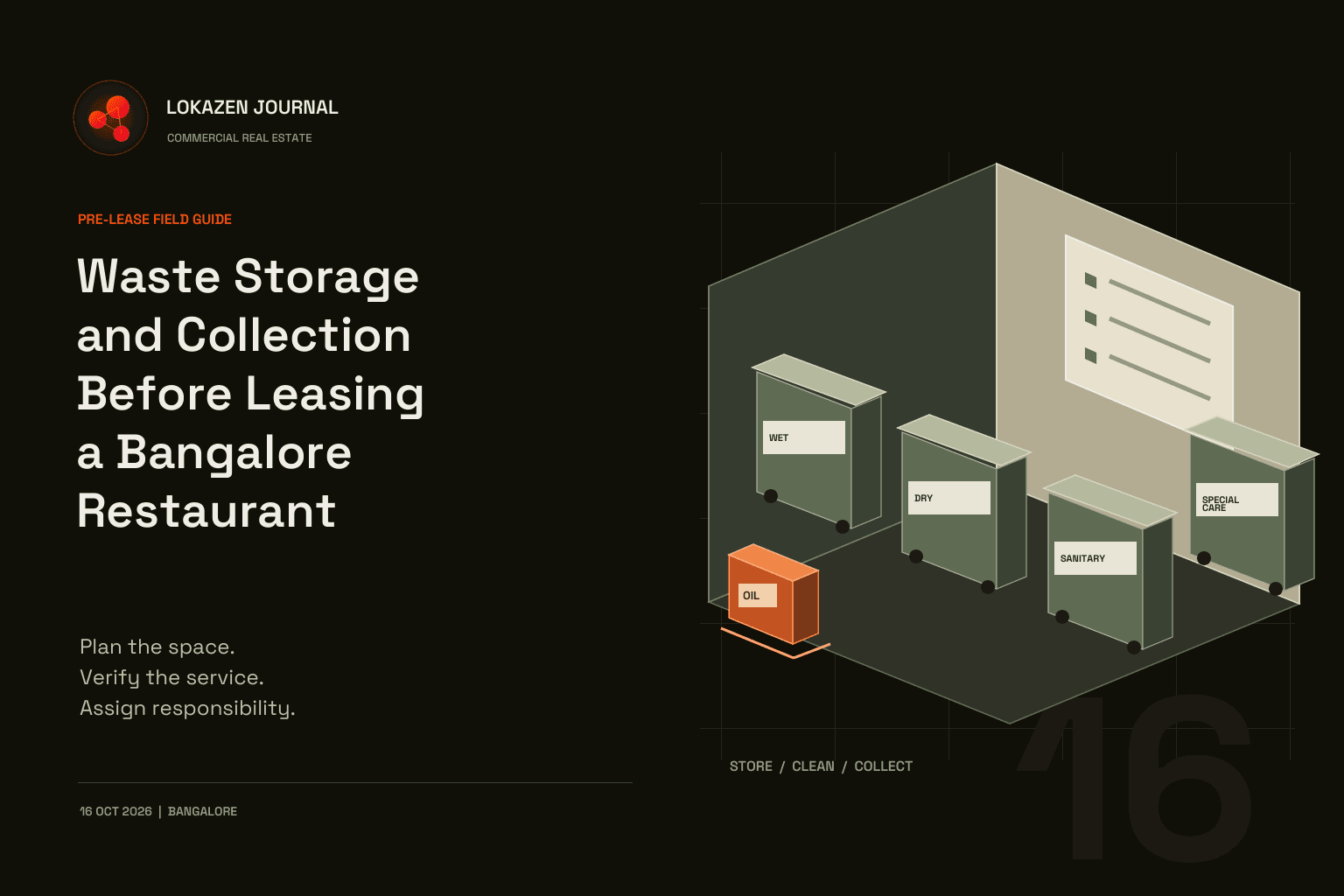
Editorial illustration. Not a listed property, verified location or measured layout.
A restaurant needs somewhere for its waste to wait safely between service and collection. That space competes with seating, stock and kitchen equipment, yet it is easy to leave off the first layout. A promise that someone collects the garbage does not establish what they collect, where it goes or what happens when they miss a visit.
Before committing to a Bangalore restaurant lease, produce three things: a waste-stream inventory, a workable storage and cleaning plan, and a written collection scope. Then agree who controls the shared facilities and who pays when arrangements fail. These checks belong in the property decision, before the fit-out makes changes expensive.
Start with the waste your menu creates
Build the inventory around preparation, service, wash-up and closing. Include takeaway packaging and stock deliveries, even if customers rarely dine in. An existing outlet with a similar menu can supply a useful starting measurement; a new concept should use a trial kitchen and label its estimates. Neither is a substitute for measuring the actual operation after opening.
Record both weight and occupied volume by stream. Wet food scraps and flattened cartons use space differently. Note the busiest service, how containers are filled and the longest credible interval before collection. A monthly average hides the particular evening when every bin is full.
| Stream to plan for | Examples in a restaurant | Question to settle before leasing |
|---|---|---|
| Wet waste | Preparation scraps and discarded food | What peak quantity must the storage and processing arrangement handle? |
| Dry waste | Separated cardboard, packaging, metal and glass | Which materials does the collector accept, and how must they be presented? |
| Sanitary waste | Used sanitary pads, diapers and similar sanitary products from toilets | Who provides separate containment and the appropriate collection service? |
| Special care waste | Relevant discarded lamps, paint containers or medicines | Which items arise here, and who is authorised to receive them? |
| Used cooking oil | Oil removed from food operations | Is there a separate, documented collection arrangement? |
| Other separately managed material | Fit-out debris, batteries, electronic equipment or grease-trap residues | Which specialist service applies rather than the routine restaurant collection? |
This is an operational inventory, not a claim that every row belongs under the same waste rules. Confirm uncertain classifications with the receiving service and competent authority. A label such as “recyclable” on packaging does not establish that the local collector accepts it when contaminated with food.
Use the current rules when assessing the premises
India's Solid Waste Management Rules, 2026 took effect on 1 April 2026 and replaced the 2016 rules. They require four source-separated streams: wet, dry, sanitary and special care waste. The government's official explanation also describes bulk-generator criteria covering floor area, water consumption and waste generation. Do not decide status solely from the size of your leased unit.
Check the Gazette, particularly rules 3, 5 and 6, with a qualified adviser and the responsible local body. Rule 6 distinguishes new bulk generators, which must provide adequate wet-waste processing facilities, from existing bulk generators seeking exemption and certificates where decentralised processing is not possible. An off-site collection contract alone should not be assumed sufficient for a new bulk-generator operation.
Ask for a written, address-specific assessment of the restaurant and any building-wide arrangement before fixing the layout. Legacy BBMP collection guidance is useful background, but contains older segregation language. It is not proof of the current service, classification or permissions at your proposed address. Use the Greater Bengaluru Authority website to identify the relevant Bengaluru city corporation, then confirm applicable implementation requirements and collector status directly.
Inspect storage as a working room
Draw the proposed containers at their actual external dimensions. Allow space to open lids, remove a full container, clean around it and replace a damaged one. Do not allocate every centimetre to tightly packed bins and assume staff will somehow manage them. Confirm that the space is genuinely available throughout the operating day rather than temporarily borrowed from another tenant.
Look at separation from food, clean utensils and packaging; surfaces that can be cleaned; pest entry points; ventilation; lighting; and protection from rain. Identify how wash water is handled. A nearby drain is not evidence that bin washing or oil disposal is permitted there. Have the plumbing and hygiene arrangement checked before accepting a proposed wash point.
FSSAI's Basic Catering training material describes covered waste containers, regular removal, washing and disinfection, drying before reuse, and separation from food processing. Translate those practices into a named location, equipment and staff responsibility. The training document is guidance, not a complete premises approval.
At the site visit, ask someone to demonstrate an empty-bin cleaning cycle. Where do gloves, brushes and cleaning products stay? Where does the clean bin dry while another remains in use? If the answer relies on the food-preparation sink or an unapproved shared corner, the layout is not resolved.
Size the system around the collection gap
Use measured or clearly labelled estimated volume for each stream. Multiply the peak daily volume by the interval you need to accommodate, then compare that figure with usable container capacity. Nominal bin capacity is not usable capacity if lids cannot close, the load becomes unsafe to handle or the collector imposes a lower fill limit.
A missed-pickup allowance is a resilience test, not permission to hold putrescible waste for that duration. A food-safety professional should determine the acceptable holding conditions and maximum interval for the particular waste and premises. If safe storage cannot cover a failure, the contingency must shorten the interval or reduce generation.
Fictional worked example one: a small cafe
Assume a trial kitchen produces 72 litres of wet waste on its busiest day. For a hypothetical two-day disruption test, the team calculates 72 × 2 = 144 litres. Two 120-litre containers, each assumed usable to 80% for this exercise, provide 192 litres. The arithmetic leaves 48 litres of spare volume.
That does not approve two-day storage. The cafe still needs its hygiene adviser to set safe conditions, and must confirm the actual containers and handling limits. At the proposed property, the team discovers that only one container fits once lid clearance and cleaning space are included. One container provides just 96 usable litres under the same assumption. The team must redesign the storage area or secure a faster, workable backup before accepting the unit.
All quantities, capacities and operating circumstances in this example are invented. They demonstrate a method, not a Bangalore benchmark or a recommended holding time.
Obtain a collector scope that can be checked
Request a proposal against your actual inventory. “Daily garbage pickup” leaves too many omissions. A dry-waste service may exclude food-soiled materials; an oil collector may not handle grease-trap residues. Record exclusions explicitly and assign another suitable service where needed.
| Contract item | Evidence to request | Failure the check helps expose |
|---|---|---|
| Accepted streams | Itemised scope, contamination limits and exclusions | One invoice masking gaps in coverage |
| Collection service | Days, time window, holidays and cut-off for reporting a miss | No service during the busiest trading period |
| Destination and standing | Receiving facility details and relevant current registrations or authorisations | A collection promise without a verified downstream arrangement |
| Quantity and price | Measurement method, included quantity, extras and taxes | Disputed weights or unexpected overflow charges |
| Contingency | Escalation contact, response commitment and permitted backup | Waste accumulating while each party waits for another |
| Records | Pickup acknowledgement, quantity log and rejection report | No evidence of what actually left the premises |
Verify documents for the relevant entity, location, activity and validity period. A logo on a vehicle or a generic certificate does not establish that the proposed service covers your waste. Ask who signs for a pickup and how partial collections or rejected material are recorded. Keep the records in a shared operating file accessible to the person managing the restaurant.
Used cooking oil deserves its own record and containment. FSSAI's RUCO framework sets out enrolment of non-food production units collecting oil from food businesses. Its handling guidance warns against drain disposal. Confirm the current eligible collection chain and any applicable reporting requirements rather than treating an informal buyer as sufficient evidence.
Divide owner and operator responsibilities in writing
The restaurant can manage segregation within its unit but may not control a common waste room, its cleaning staff or the building's collector. Conversely, an owner providing space does not automatically take over the operator's duties. Use the lease and service documents to allocate practical tasks without implying that statutory obligations disappear.
| Responsibility | Proposed accountable party | Detail to document |
|---|---|---|
| Segregation and staff training | Restaurant operator | Shift checks and corrective action |
| Dedicated storage provision | Owner or operator, as agreed | Identified area, permitted use and continuing access |
| Common-room cleaning | Building manager or appointed contractor | Frequency, supplies, inspection and incident response |
| Collection appointment and payment | Named contracting party | Scope, invoices, renewals and records |
| Overflow or rejected loads | Operator and building manager | Immediate response and cost allocation |
| Processing or material alterations | Relevant responsible parties | Approvals, capacity, funding and maintenance |
These are negotiation prompts, not model legal clauses. Have the final obligations and remedies reviewed appropriately. Include what happens if shared space is withdrawn, another restaurant joins the building, or the collection service changes. Broader ownership and document checks belong alongside this schedule; Lokazen's Papers Before Keys explains that wider preparation.
Fictional worked example two: a shared building
A fictional restaurant forecasts 180 litres of dry packaging on a busy day after flattening cartons. A shared store offers two nominal 240-litre bins, each assumed usable to 75%: 360 litres in total. The neighbouring tenant already needs 120 litres of that capacity, leaving 240 litres. If two busy days occur between collections, the restaurant alone would need 360 litres, producing a 120-litre shortfall against its actual allocation.
The owner initially describes the entire 480-litre nominal capacity as available. The joint inventory reveals the mistake. The parties agree to reassess dedicated allocation and service frequency before signing. They also separate the oil-service quotation from the routine collection proposal, which expressly excludes it. These are invented inputs and decisions; the usable-fill assumptions require verification for a real site.
Write the missed-pickup procedure before opening
Assign a shift lead to check whether the scheduled collection actually occurred. Record the time, remaining quantity, any rejected stream and the collector's response. Establish when to escalate to the building manager and when the approved backup is called. Include holidays and the possibility that the usual contact does not answer.
Define a clear operating trigger based on remaining safe capacity and holding conditions. Where collection cannot be restored in time, the manager needs authority to reduce waste-generating activity or suspend the affected operation safely. Moving bags beside the building or combining separated streams is not a contingency plan.
Before lease commitment, close this checklist:
- Inventory complete, with peak quantities and assumptions identified
- Storage allocation drawn, inspected and accepted by the relevant parties
- Cleaning, wash-water handling and pest-control responsibilities confirmed
- Current classification and processing requirements checked for the address
- Collector scope, downstream arrangements and excluded streams verified
- Missed-pickup response, backup and escalation responsibilities documented
- Fit-out costs, shared charges and outstanding decisions included in the property comparison
Use these findings alongside rent, customer demand and the rest of the operating brief. As Five scores is not a lease puts the broader decision in context, a shortlist still needs property-level evidence. Bring the waste inventory into your Lokazen location search so the space being assessed reflects how the restaurant will actually run.
Sources and scope
Sources checked for the 16 October 2026 edition include the SWM Gazette and official explanation, FSSAI catering and oil guidance, legacy BBMP material and the Greater Bengaluru Authority website. Links accompany the discussion; live Lokazen links were checked separately.
This operational guide is not legal advice or a premises approval. Verify local requirements and permissions directly. Both examples are fictional; capacity allowances are planning assumptions, not regulatory specifications or market data.
Frequently asked questions
- Is a bin outside the kitchen enough?
- Only if the complete arrangement works: appropriate separation, sufficient usable capacity, hygienic storage, cleaning and an accepted collection service. Its presence alone proves none of those things.
- Can I use an older three-stream checklist?
- Update it. The 2026 national framework specifies four streams. Check local implementation and any separately regulated materials rather than relabelling every discarded item as ordinary dry waste.
- Does the landlord's collector cover my restaurant?
- Ask for written coverage of your unit, quantities and waste types. Confirm who pays, who receives records and who handles exclusions. A building contract may not include your proposed operation.
- How large should the waste room be?
- There is no universal size established by this guide. Start with measured peak volumes, service intervals, actual container dimensions and safe working clearances; have the proposed conditions assessed for your operation.
- Should cooking oil go in the wet-waste bin?
- Arrange separate handling for discarded cooking oil and verify its eligible collection chain. Do not assume the routine wet-waste contractor accepts it or that drainage is a disposal option.
- What if the site cannot accommodate processing?
- Resolve applicable requirements before leasing. In particular, the Gazette treats new and existing bulk generators differently. Obtain a competent, address-specific assessment rather than assuming an outside pickup solves the issue.
- What is the strongest reason to pause a lease?
- An unresolved gap between waste generation, safe storage and the verified service. If nobody can show who handles that gap, the restaurant is accepting an operating problem before opening.
Read next
- Playbook
Pest Risk Before Leasing a Bangalore Commercial Space
13 min read
- Playbook
Broadband and Mobile Connectivity Before Leasing a Bangalore Commercial Space
10 min read
- Playbook
Noise and Neighbour Compatibility Before Leasing a Bangalore Commercial Space
10 min read
- Playbook
Checking Kitchen Exhaust Before Leasing a Bangalore Restaurant
10 min read
- Playbook
How to Check Water Supply and Drainage Before Leasing a Bangalore Restaurant
10 min read
- Playbook

Comparing Commercial Fit Out Quotations in Bangalore
10 min read
Work with Lokazen
Brands get scored Bangalore shortlists from verified listings. Owners get their space in front of brands that are actively looking.
More data-led guides on the Lokazen blog.